In news that’s surprisingly not bad, a lot of Nintendo Switch games are on sale.
from Wired https://ift.tt/3hlVw34
via Gabe's Musing's

Saturday, August 22, 2020
Friday, August 21, 2020
Celebs raise $7M for Biden-Harris campaign after convention
The event occurred the day after the former VP accepted the Democratic nomination for President.
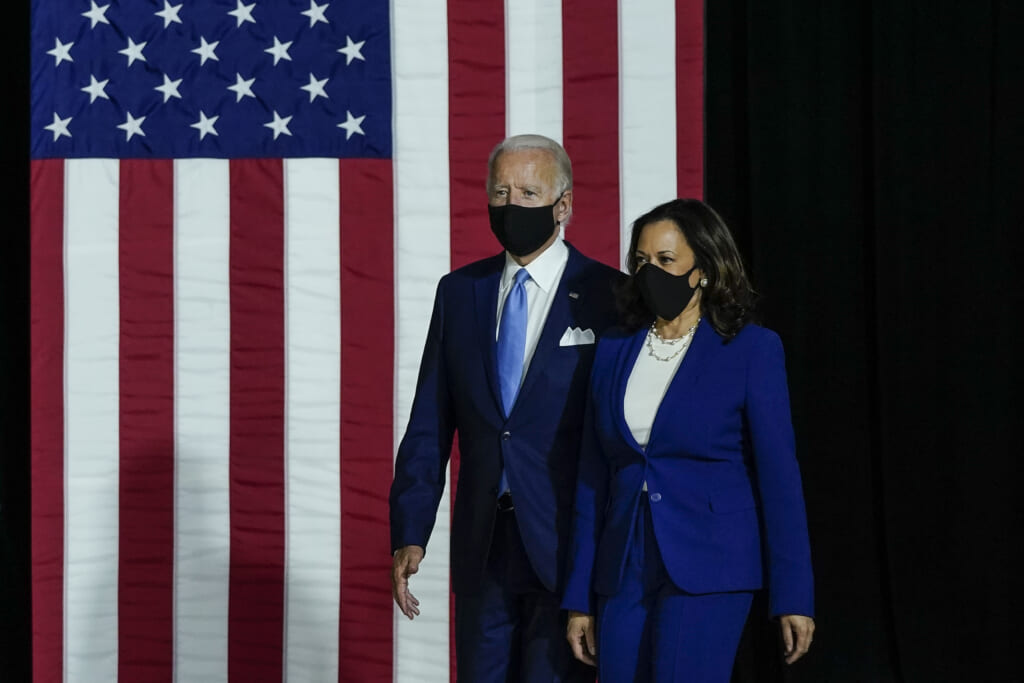
Byron Allen, Jeffrey Katzenberg and George Clooney co-hosted a virtual fundraiser Friday (Aug. 21) for Joe Biden’s presidential campaign, raising $7 million from about 25 Hollywood Democratic donors.
The intimate virtual event was organized by consulting firm GLS, and featured appearances from Biden, running mate Kamala Harris, and their spouses.
Allen and his wife Jennifer Lucas co-hosted the event with Katzenberg and his wife Marilyn, Mayor Eric Garcetti, Ellen Bronfman Hauptman and Andrew Hauptman, and Clooney and his wife Amal, Deadline reports.
Read More: Biden vows to defeat Trump, end US ‘season of darkness’
In a statement, Quibi founder Katzenberg said, “We are in the home stretch now. There is no question this is the most consequential election of our lifetime.”
Allen, the founder and CEO of Entertainment Studios and Allen Media Group, said, “This is an extremely important moment in our nation’s history. We must all lean in, and I strongly believe Joe Biden and Kamala Harris will give America the leadership and the must-needed change that we all deserve.”
Hauptman, chairman of Andell Inc., added, “Ellen and I are proud to lock arms with our co-hosts in support of the Biden-Harris campaign. The change coming in November can’t come fast enough.”
Biden and Harris previously announced at a grassroots fundraising event that his campaign had raised over $26 million in the first 24 hours after his running mate announcement. After 48 hours, a reported 48 million was raised.
Friday’s event was hosted the day after the former vice president accepted the Democratic nomination for President.
theGrio previously reported, in his strongest remarks of the campaign, Biden spoke both of returning the United States to its traditional leadership role in the world and of the deeply personal challenges that shaped his life. Virtually every sentence of his 22-minute speech was designed to present a sharp, yet hopeful, contrast with the Republican incumbent.
“Here and now I give you my word: If you entrust me with the presidency, I will draw on the best of us not the worst. l’ll be an ally of the light, not the darkness,” Biden said. “Make no mistake, united we can and will overcome this season of darkness in America.”
Have you subscribed to theGrio’s podcast “Dear Culture”? Download our newest episodes now!
The post Celebs raise $7M for Biden-Harris campaign after convention appeared first on TheGrio.
from TheGrio https://ift.tt/2QddJUz
via Gabe's Musing's
Only 11 percent of Senate aides are POC, study finds
The report found only 3.1 percent of top staff positions are held by Black people.
Diversity among top Senate staffers in Washington offices remains overwhelmingly white, which continues to receive scrutiny amid the Black Lives Matter movement and the COVID-19 crisis.
While people of color make up 40 percent of the American population, only 11 percent of top staff in Senate offices represent this group, according to a new study conducted by LaShonda Brenson of the Joint Center for Political and Economic Studies, nonpartisan think tank.
Brenson defines “top staff” in Senate offices of the chief of staff, legislative director and communications director. Overall, the report found only 3.1 percent of top staff positions are held by Blacks, 3.8 percent are Latinos and Asian American/Pacific Islanders makeup 2.7 percent, per the New York Times.
Read More: Senate details Trump campaign’s contact with Russia, draws final conclusion
Seven senators reportedly have staff that are over 50 percent nonwhite. Sen. Corey Booker (D-N.J.) allegedly has the most diverse staff, with 65 percent nonwhite.

Sen. Brian Schatz of Hawaii had the second-most diverse staff, with 64 percent non-Caucasian. When it comes former presidential candidate Sen. Kamala Harris of California, 28 percent of her staff reportedly identified as Latino and 26 percent as Black.
“A lot of it has to do with how hiring is done on the Hill. A lot of times the folks who are in these positions to make hiring decisions often times choose within their own network that is likely not diverse,” Brenson told The Hill as to why the diversity problem persists.
“I think hiring managers need to think more about not just what is on someone’s résumé, while important, but also the kind of experiences that can’t be written on a résumé, but can be felt in a room when you’re negotiating policy, when you’re interacting with different communities and different constituents,” she added.
Benson called out the Trump administration’s response to how the COVID-19 crisis has disproportionately hurt Black Americans. Perhaps a more diverse staff would support inclusive legislation that provides “significant relief,” she said.
“If you look at what’s going on right now with the pandemic, African Americans, specifically, are disproportionately dying and getting ill from COVID-19. There’s a failure in the Trump administration and Congress to enact real policy that going to provide significant relief,” Benson said.
Have you subscribed to theGrio’s podcast “Dear Culture”? Download our newest episodes now!
The post Only 11 percent of Senate aides are POC, study finds appeared first on TheGrio.
from TheGrio https://ift.tt/2EsVyYl
via Gabe's Musing's
5 Highlighting Moments From the DNC You’ll Want to Watch Again

The promise of equality, liberty, and justice underscored the 2020 Democratic National Convention this week. The four-day virtual event featured a number of establishment leaders, Party favorites, celebrity performances, and testimonies from everyday people struggling in Trump’s America. From race relations to immigration to climate change to women’s rights, the convention stressed how these issues are being exacerbated under the Trump administration. The speakers also emphasized how the White House has failed to protect Americans from the global COVID-19 pandemic while highlighting the calls for justice for George Floyd and Breonna Taylor.
The DNC culminated in a final acceptance speech from Joe Biden, who opened with a quote from civil rights activist Ella Baker.
“Ella Baker, a giant of the civil rights movement, left us with this wisdom: Give people light and they will find a way,” he said. “Give people light. Those are words for our time. The current president has cloaked America in darkness for much too long. Too much anger. Too much fear. Too much division,” he continued. “Here and now, I give you my word: If you entrust me with the presidency, I will draw on the best of us, not the worst. I will be an ally of the light, not of the darkness,” he said.
Here are five of the best moments from the 2020 DNC.
Kamala Harris Accepts the VP Nomination
Sen. Kamala Harris made history Wednesday evening, becoming the first Black woman to accept the nomination as vice-presidential candidate for the Democratic Party. During her speech, the HBCU grad praised her mother, who immigrated from India at the age of 19 years old, and emphasized how Black and brown communities are being affected by the coronavirus and systemic racism.
“Black, Latino, and Indigenous people are suffering and dying disproportionately,” Harris said. “This is not a coincidence. It is the effect of structural racism, of inequities in health care and housing, job security, and transportation. The injustice in reproductive and maternal health care.”
Michelle Obama Slams Trump
The convention kicked off Monday night with former first lady Michelle Obama, who delivered a passionate speech, stressing the importance of voting and her support for Joe Biden. She also offered sharp criticism of President Trump.
“So, let me be as honest and clear as I possibly can. Donald Trump is the wrong president for our country,” she said. “He has had more than enough time to prove that he can do the job, but he is clearly in over his head. He cannot meet this moment. He simply cannot be who we need him to be for us. It is what it is.”
Obama, who wore a VOTE necklace by a Black designer, also noted how Trump has failed to address the COVID-19 pandemic and the ongoing Black Lives Matter protests.
“Now, I understand that my message won’t be heard by some people. We live in a nation that is deeply divided, and I am a Black woman speaking at the Democratic Convention,” she continued. “But enough of you know me by now. You know that I tell you exactly what I’m feeling. You know I hate politics. But you also know that I care about this nation. You know how much I care about all of our children.”
Barack Obama’s Sober Speech
Rather than offering words of hope and inspiration, former President Barack Obama delivered a speech that warned Americans about the devastation that would be caused if Trump is reelected.
“Do not let them take away your power,” Obama said during his stark address from Philadelphia. “Don’t let them take away your democracy.”
Viral Security Guard Sensation Endorses Joe Biden
A security guard at The New York Times, who went viral last year after meeting Biden in an elevator, was the first person to nominate him at the convention.
“I take powerful people up on my elevator all the time. When they get off, they go to their important meetings. Me? I just head back to the lobby. But in the short time I spent with Joe Biden, I could tell he really saw me, that he actually cared, that my life meant something to him,” said Jacquelyn Brittany, who escorted Biden through the Times building and blurted out “I love you” on camera.
“And I knew, that even when he went into his important meeting, he’d take my story in there with him,” Brittany continued. “We’ve been through a lot, and we have tough days ahead, but nominating someone like that to be in the White House is a good place to start. “That’s why I nominate my friend as the next president of the United States,” Brittany concluded.
Jacquelyn Brittany nominates “my friend” Joe Biden for president of the United States.
She is a security guard who last year told Biden “I love you” as she escorted him in an elevator. pic.twitter.com/lW1Ji4In9o
— PBS NewsHour (@NewsHour) August 19, 2020
Colin Powell Endorses Joe Biden
Former Secretary of State Colin Powell was one of several Republicans who endorsed the Democratic presidential candidate at the convention.
“The values I learned growing up in the South Bronx and serving in uniform were the same values that Joe Biden’s parents instilled in him in Scranton, Pennsylvania. I support Joe Biden for the presidency of the United States because those values still define him, and we need to restore those values to the White House,” Powell said in a video released by the DNC ahead of the second night of convention programming.
Powell served as the Secretary of State from 2001 to 2005 in George W. Bush’s administration. Other noted Republicans who appeared at the DNC included former Ohio Gov. John Kasich and Cindy McCain, the wife of late Sen. John McCain.
from Black Enterprise https://ift.tt/31iLsCB
via Gabe's Musing's
‘Nellyville’ producer charged in plot to kill Sweetie Pie owner’s nephew
Waiel ‘Wally’ Yaghnam allegedly conspired with the victim’s uncle, Timothy Norman, in the murder scheme.
A St. Louis record producer behind Nelly’s 2002 hit album “Nellyville” has been indicted in connection with the murder-for-hire plot to kill the grandson of Sweetie Pie’s owner Robbie Montgomery.
Federal prosecutors say Waiel “Wally” Yaghnam, 42, a music producer-turned insurance agent, worked with Timothy Norman, 41, Montgomery’s son, to fraudulently obtain a life insurance policy on his nephew, 21-year-old Andre Montgomery Jr., St. Louis Dispatch reports.
Yaghnam worked as Norman’s insurance agent, and faces one charge of conspiracy to commit wire and mail fraud after he allegedly made false statements on life insurance applications for Montgomery, prosecutors allege.
Read More: Sweetie Pie’s owner charged in murder for hire plot in nephew’s death
theGRIO previously reported, Norman and his alleged co-conspirator, Terica Ellis, were arrested on federal charges earlier this week over the death of Montgomery, for whom Norman obtained a $450,000 life insurance policy in 2014. The nephew was fatally shot in St. Louis two years later. Norman tried unsuccessfully to collect on the policy one week after his death.
Norman, who starred in the OWN reality series Welcome to Sweetie Pie’s, was charged on Tuesday with conspiracy to use interstate commerce facilities in the commission of a murder-for-hire, resulting in death, according to a criminal complaint published by local TV station WLBT.
Prosecutors connected him to the shooting based on his alleged communications with Ellis.
Ellis used a prepaid cell phone “to communicate with Montgomery and learn his physical location for the purpose of luring Montgomery outside,” according to a news release obtained by The Associated Press. “Immediately after learning Montgomery’s location, Ellis placed a call to Norman.”
Authorities have not said who shot the victim, but Yaghnam is not charged in the murder.
Read More: ‘Welcome to Sweetie Pie’s’ Miss Robbie suing son Tim
As a business partner in Sweetie Pie’s, Norman’s mother sued him in 2016 for copyright infringement after he opened several restaurants outside the St. Louis market.
Both Norman and his nephew appeared on OWN’s Sweetie Pie’s, which followed the restaurant family business in Mississippi and aired for nine seasons on OWN from 2011 to 2018.
Have you subscribed to theGrio’s podcast “Dear Culture”? Download our newest episodes now!
The post ‘Nellyville’ producer charged in plot to kill Sweetie Pie owner’s nephew appeared first on TheGrio.
from TheGrio https://ift.tt/3j28bIV
via Gabe's Musing's
11 Tips for Creating Work/Life Balance in the Virtual Workplace

When you work remotely—as so many people are doing in the age of COVID-19—there’s no natural boundary between your workday and the rest of your life. Jackie Gaines, an award-winning senior executive with more than 40 years of sustained leadership experience, shows you how to build and maintain greater work/life balance so work doesn’t take over everything else.
According to a recent report, the average “pandemic workday” is 48.5 minutes longer than before. It also shows we are attending about 13% more meetings and sending 1.4 more emails per day to our colleagues. But this uptick in productivity has a downside: It’s destroying many people’s work/life balance.
“Our work/life balance is already in jeopardy thanks to the impact of COVID-19,” says Gaines, author of Wearing the Yellow Suit: A Guide for Women in Leadership. “Extended workdays only intensify the situation. We are all working hard at our jobs while trying to homeschool our kids, keep the household in order, and still carve out time to connect with loved ones and enjoy our lives. It’s a challenge for everyone.”
When you work from home, the “workday” becomes a slippery slope—especially when you’re constantly interrupted by your kids to help them get their schoolwork done online. If you’re not careful, meeting your work demands in this chaotic environment can crowd out your other priorities. But Gaines says you can take back control by getting very intentional about protecting your work/life balance in these unusual times.

“We all need time to recharge from work,” says Gaines. “By setting some healthy habits for greater balance, you’ll be a much better employee or leader during work hours, and you’ll have more energy and focus for the other things you value.”
Here is your to-do list for living a balanced life:
Recognize the need for balance and commit to addressing it in your life. If you just devote all your time to work, then you’re going to be neglecting the social, spiritual, and a multitude of other important aspects of your life. Be a whole person; be fulfilled in all different aspects of your life.
Figure out what works for you. The “right balance” is a very personal thing and will change for each person at different times in their lives. There is no “one-size-fits-all.” What we need as a young adult is very different from what we need in our senior years … it also may be very different based on our culture, our gender, or any variety of factors. The point is … it is unique for each of us, but definitely something that we all require in our lives.
Beware of the technology chains that bind. Cell phones and PCs blur the distinction between work and personal time. Don’t fall victim to this temptation.
“In the age of nonstop virtual work meetings, you’re probably already sick of technology by the end of the workday,” says Gaines. “Spend time outside of work away from your devices. Have a conversation with someone in your household. Take a short walk for fresh air. Read a chapter in a book.”
Use your faith to help put life into perspective. “Faith makes all things possible,” says Gaines. “It offers me a healthy way to balance all personal, interpersonal, work-related, and community responsibilities. It is a rock to stand on in this crazy world … strength.”
Be organized. The most important issues related to having a good balance are organization, planning, and time management. This could mean planning meals a week in advance, laying out clothes the night before, and spending as much evening time with young children as possible.

Recognize that balance takes work. Balance is a necessary part of life—especially right now. It’s up to you to manage it. The choices made have costs and benefits associated with them. It is something that always has to be kept in mind to ensure that no component is neglected for too long. Here are some choices to think about:
- Consciously separate work and home.
- Consciously put family first.
- Work fewer hours. In work-from-home scenarios, set boundaries between work time and leisure time.
- Choose shift work so one partner is home to care for other family members.
- Learn to make do with less.
Have goals. Know your goal and plan accordingly. Know your priorities in life and what’s important.
Don’t sweat the small stuff. “I don’t stress out about daily life situations and I remember how fortunate I am to be healthy and safe,” says Gaines. “Most of all, you live only once and you need to strive for what you want and make the best of it. I don’t want to regret anything I didn’t do now when I am older.”
Enjoy life—focus on what is going well, not what is stressful. Take time to play, laugh, love, work, cry together, and respect each other. We all make mistakes at home and work. Take time for yourself and smile.
Remain fit and use exercise as a way to deal with stress. “I feel people who exercise regularly are better able to handle stress,” says Gaines. “Whether it’s 5:00 a.m. or 6:00 in the evening, exercising can improve the quality of your day. I also believe in recognizing the need for leisure activities that you enjoy, feeling connected to the community, and having goals for the future.”
Make a date with yourself. “You have probably heard about this trend for married couples to have a date night actually scheduled,” says Gaines. “I would like to push you into starting a new trend: date night, or morning … lunch … weekend … with yourself. If scheduling works best for you (it does for me), go for it! During your date time, do whatever it is that makes you happy—exercise, read, meditate, pray—whatever gives you just a small break for yourself. You will be surprised at the change you immediately start to feel in the quality of your life.”
Remember, there is no magic pill that helps you find balance. We have to spark that journey in ourselves or continue on the cycle of madness. Finding balance has to be a priority.
“A balanced life does not equate to 50/50 at all times either,” concludes Gaines. “However, if we are always running crazy, we will eventually implode. Strive to tilt the scales in the other direction periodically.”
from Black Enterprise https://ift.tt/2Yj2Ncr
via Gabe's Musing's
15+ practical Python projects with full walk-through tutorials
15+ practical Python projects for beginners. Use these projects to learn to code, build useful apps or build your portfolio.
from Codementor Community https://ift.tt/3hiuBp4
via Gabe's MusingsGabe's Musings
from Codementor Community https://ift.tt/3hiuBp4
via Gabe's MusingsGabe's Musings
Thursday, August 20, 2020
Biden vows to defeat Trump, end US ‘season of darkness’
‘If you entrust me with the presidency, I will draw on the best of us not the worst,’ the Democratic presidential nominee said on Thursday night.
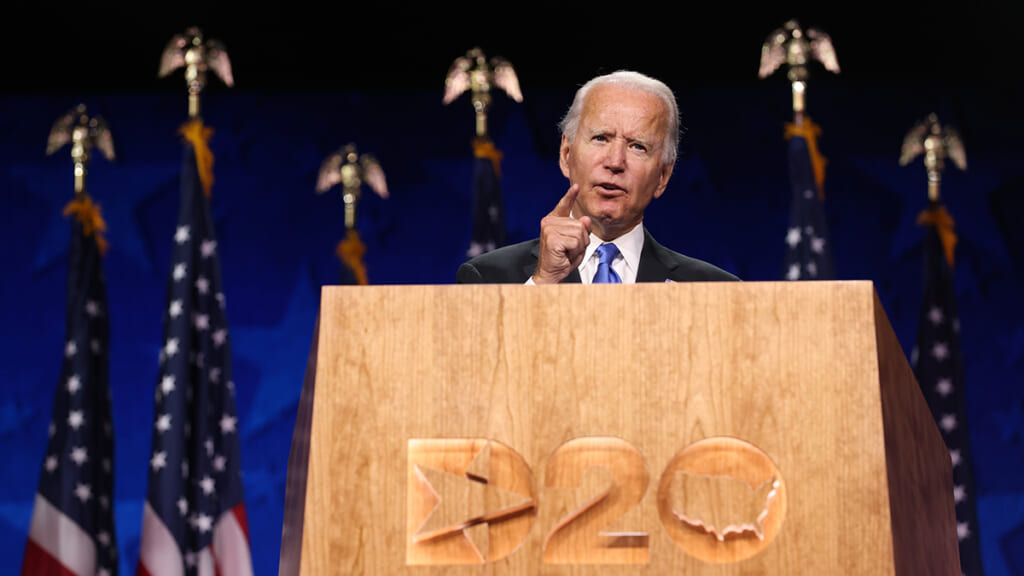
WILMINGTON, Del. (AP) — Joe Biden accepted the Democratic presidential nomination Thursday night with a vow to be a unifying “ally of the light” who would move an America in crisis past the chaos of President Donald Trump’s tenure.
In his strongest remarks of the campaign, Biden spoke both of returning the United States to its traditional leadership role in the world and of the deeply personal challenges that shaped his life. Virtually every sentence of his 22-minute speech was designed to present a sharp, yet hopeful, contrast with the Republican incumbent.
“Here and now I give you my word: If you entrust me with the presidency, I will draw on the best of us not the worst. l’ll be an ally of the light, not the darkness,” Biden said. “Make no mistake, united we can and will overcome this season of darkness in America.”
Read More: Joe Biden, Kamala Harris talk ‘modern family’ values in 1st joint interview
For the 77-year-old Biden, the final night of the Democratic National Convention was bittersweet. He accepted a nomination that had eluded him for over three decades because of personal tragedy, political stumbles and rivals who proved more dynamic.
But the coronavirus denied him the typical celebration, complete with the customary balloon drop that both parties often use to fete their new nominees. Instead, Biden spoke to a largely empty arena near his Delaware home.
Afterward, fireworks lit the sky outside the arena where supporters waited in a parking lot, honking horns and flashing headlights in a moment that finally lent a jovial feel to the event.
The keynote address was the speech of a lifetime for Biden, who would be the oldest president ever elected if he defeats Trump in November. Trump, who is 74, publicly doubts Biden’s mental capacity and calls him “Slow Joe,” but with the nation watching, he was firm and clear.
Still, the convention leaned on a younger generation earlier in the night to help energize his sprawling coalition.
Tammy Duckworth, an Illinois senator who lost both legs in Iraq and is raising two young children, said Biden has “common decency.”
Cory Booker, only the ninth African American senator in U.S. history, said Biden believes in the dignity of all working Americans.
And Pete Buttigieg, the 38-year-old former South Bend, Indiana, mayor and a gay military veteran, noted that Biden came out in favor of same-sex marriage as vice president even before President Barack Obama.
“Joe Biden is right, this is a contest for the soul of the nation. And to me that contest is not between good Americans and evil Americans,” Buttigieg said. “It’s the struggle to call out what is good for every American.”
Above all, Biden focused on uniting the nation as Americans grapple with the long and fearful health crisis, the related economic devastation, a national awakening on racial justice — and Trump, who stirs heated emotions from all sides.
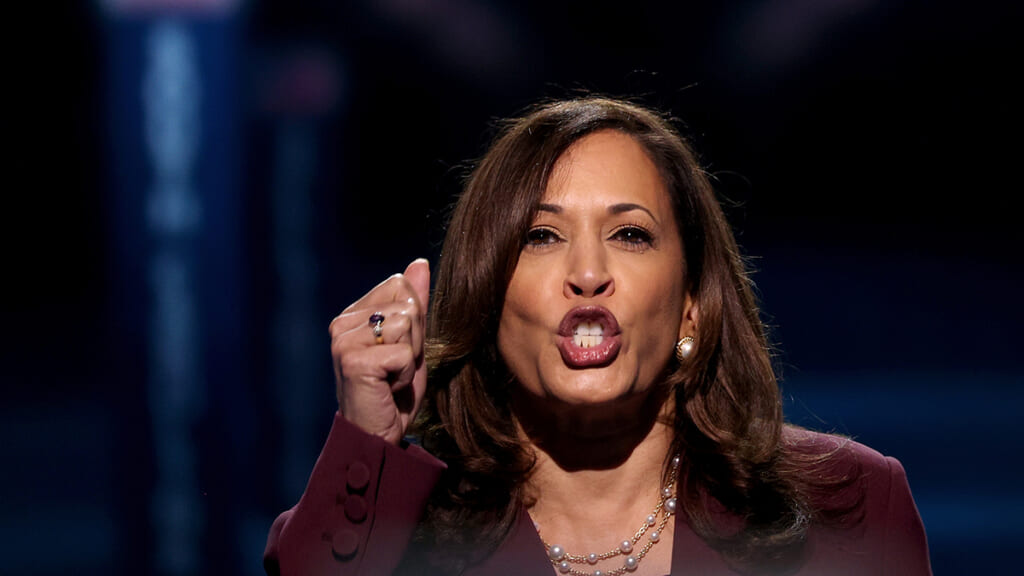
Biden’s positive focus Thursday night marked a break from the dire warnings offered by former President Obama and others the night before. The 44th president of the United States warned that American democracy itself could falter if Trump is reelected, while Biden’s running mate, Kamala Harris, the 55-year-old California senator and daughter of Jamaican and Indian immigrants, warned that Americans’ lives and livelihoods were at risk.
Read More: Kamala Harris says ‘there is no vaccine for racism’ in rousing DNC speech
Biden’s Democratic Party has sought this week to put forward a cohesive vision of values and policy priorities, highlighting efforts to combat climate change, tighten gun laws and embrace a humane immigration policy. They have drawn a sharp contrast with Trump’s policies and personality, portraying him as cruel, self-centered and woefully unprepared to manage virtually any of the nation’s mounting crises and policy challenges.
Voting was another prime focus of the convention on Thursday as it has been all week. Democrats fear that the pandemic — and Trump administration changes at the Postal Service — may make it difficult for voters to cast ballots in person or by mail.
Comedian Sarah Cooper, a favorite of many Democrats for her videos lip syncing Trump’s speeches, put it bluntly: “Donald Trump doesn’t want any of us to vote because he knows he can’t win fair and square.”
Read More: Sarah Cooper gets Netflix special after going famous for trolling Trump
Biden’s call for unity comes as some strategists worry that Democrats cannot retake the White House simply by tearing Trump down, that Biden needs to give his sprawling coalition something to vote for. That’s easier said than done in a modern Democratic Party made up of disparate factions that span generation, race and ideology.
Though he has been in the public spotlight for decades as a Delaware senator, much of the electorate knows little about Biden’s background before he began serving as Obama’s vice president in 2008.
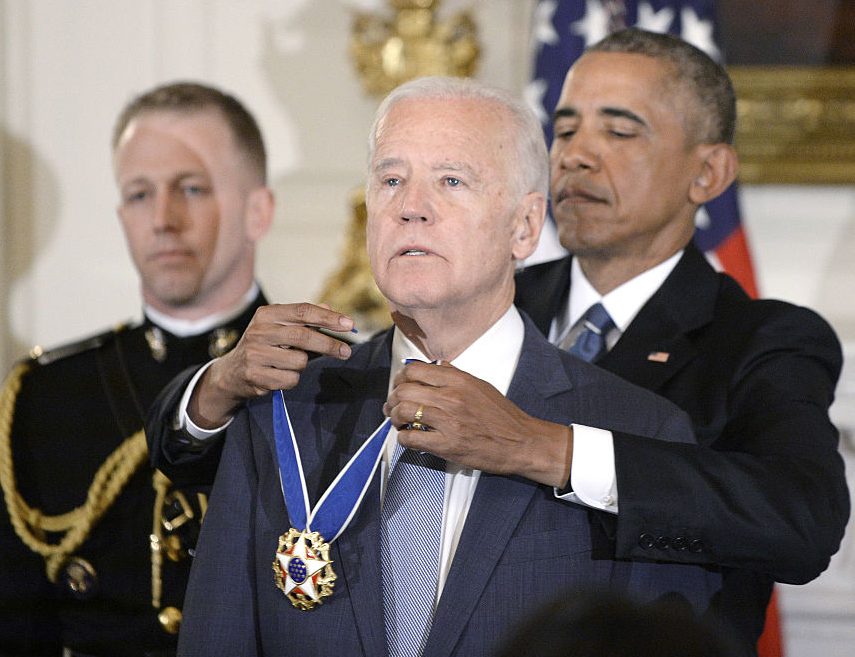
Thursday’s convention served as a national reintroduction of sorts that drew on some of the most painful moments of his life.
“I know how mean and cruel and unfair life can be sometimes,” Biden said. He added: “I found the best way through pain and loss and grief is to find purpose.”
As a schoolboy, Biden was mocked by classmates and a nun for a severe stutter. He became a widower at just 30 after losing his wife and infant daughter to a car accident. And just five years ago, he buried his eldest son who was stricken by cancer.
From such hardship, Biden developed a deep sense of empathy that has defined much of his political career. And throughout the convention, Biden’s allies testified that such empathy, backed by decades of governing experience, makes him the perfect candidate to guide the nation back from mounting health and economic crises.
His allies Thursday included Brayden Harrington, a 13-year-old boy from Concord, New Hampshire. The boy said he and Biden were “members of the same club,” each with a stutter they’re working to overcome.
He noted that Biden told him about a book of poems he liked to read aloud to practice his speech and showed the boy how he marks his speeches so they’re easier to read aloud.
“I’m just a regular kid, and in a short amount of time, Joe Biden made me more confident about a thing that’s bothered me my whole life,” Harrington said.
The end of the carefully scripted convention now gives way to a far less-predictable period for Biden and his Democratic Party as the 2020 election season speeds to its uncertain conclusion. While Election Day isn’t until Nov. 3, early voting gets underway in several battleground states in just one month.
Biden has maintained a polling advantage over Trump for much of the year, but it remains to be seen whether the Democratic nominee’s approach to politics and policy will genuinely excite the coalition he’s courting in an era of uncompromising partisanship.
Trump’s Republican Party is expected to deliver a message next week squarely focused on the president’s most loyal supporters..
Biden summed up his view of the campaign: “We choose a path of becoming angry, less hopeful and more divided, a path of shadow and suspicion, or we can choose a different path and together take this chance to heal.”
Have you subscribed to theGrio’s podcast “Dear Culture”? Download our newest episodes now!
The post Biden vows to defeat Trump, end US ‘season of darkness’ appeared first on TheGrio.
from TheGrio https://ift.tt/329nhFX
via Gabe's Musing's
Want to travel overseas? This website shows where you're allowed to go during the pandemic
A new website helps travelers plan for trips by collating Covid-19 information related to tourist restrictions, entrance requirements, lockdown limitations, and outbreak details for countries all over the world.
from Wealth https://ift.tt/31ekbB2
via Gabe's MusingsGabe's Musings
from Wealth https://ift.tt/31ekbB2
via Gabe's MusingsGabe's Musings
Real-time data for a better response to disease outbreaks
Kinsa was founded by MIT alumnus Inder Singh MBA ’06, SM ’07 in 2012, with the mission of collecting information about when and where infectious diseases are spreading in real-time. Today the company is fulfilling that mission along several fronts.
It starts with families. More than 1.5 million of Kinsa’s “smart” thermometers have been sold or given away across the country, including hundreds of thousands to families from low-income school districts. The thermometers link to an app that helps users decide if they should seek medical attention based on age, fever, and symptoms.
At the community level, the data generated by the thermometers are anonymized and aggregated, and can be shared with parents and school officials, helping them understand what illnesses are going around and prevent the spread of disease in classrooms.
By working with over 2,000 schools to date in addition to many businesses, Kinsa has also developed predictive models that can forecast flu seasons each year. In the spring of this year, the company showed it could predict flu spread 12-20 weeks in advance at the city level.
The milestone prepared Kinsa for its most profound scale-up yet. When Covid-19 came to the U.S., the company was able to estimate its spread in real-time by tracking fever levels above what would normally be expected. Now Kinsa is working with health officials in five states and three cities to help contain and control the virus.
“By the time the CDC [U.S. Centers for Disease Control] gets the data, it has been processed, deidentified, and people have entered the health system to see a doctor,” say Singh, who is Kinsa’s CEO as well as its founder. “There’s a huge delay from when someone contracts an illness and when they see a doctor. The current health care system only sees the latter; we see the former.”
Today Kinsa finds itself playing a central role in America’s Covid-19 response. In addition to its local partnerships, the company has become a central information hub for the public, media, and researchers with its Healthweather tool, which maps unusual rates of fevers — among the most common symptom of Covid-19 — to help visualize the prevalence of illness in communities.
Singh says Kinsa’s data complement other methods of containing the virus like testing, contact tracing, and the use of face masks.
Better data for better responses
Singh’s first exposure to MIT came while he was attending the Harvard University Kennedy School of Government as a graduate student.
“I remember I interacted with some MIT undergrads, we brainstormed some social-impact ideas,” Singh recalls. “A week later I got an email from them saying they’d prototyped what we were talking about. I was like, ‘You prototyped what we talked about in a week!?’ I was blown away, and it was an insight into how MIT is such a do-er campus. It was so entrepreneurial. I was like, ‘I want to do that.’”
Soon Singh enrolled in the Harvard-MIT Program in Health Sciences and Technology, an interdisciplinary program where Singh earned his master’s and MBA degrees while working with leading research hospitals in the area. The program also set him on a course to improve the way we respond to infectious disease.
Following his graduation, he joined the Clinton Health Access Initiative (CHAI), where he brokered deals between pharmaceutical companies and low-resource countries to lower the cost of medicines for HIV, malaria, and tuberculosis. Singh described CHAI as a dream job, but it opened his eyes to several shortcomings in the global health system.
“The world tries to curb the spread of infectious illness with almost zero real-time information about when and where disease is spreading,” Singh says. “The question I posed to start Kinsa was ‘how do you stop the next outbreak before it becomes an epidemic if you don’t know where and when it’s starting and how fast it’s spreading’?”
Kinsa was started in 2012 with the insight that better data were needed to control infectious diseases. In order to get that data, the company needed a new way of providing value to sick people and families.
“The behavior in the home when someone gets sick is to grab the thermometer,” Singh says. “We piggy-backed off of that to create a communication channel to the sick, to help them get better faster.”
Kinsa started by selling its thermometers and creating a sponsorship program for corporate donors to fund thermometer donations to Title 1 schools, which serve high numbers of economically disadvantaged students. Singh says 40 percent of families that receive a Kinsa thermometer through that program did not previously have any thermometer in their house.
The company says its program has been shown to help schools improve attendance, and has yielded years of real-time data on fever rates to help compare to official estimates and develop its models.
“We had been forecasting flu incidence accurately several weeks out for years, and right around early 2020, we had a massive breakthrough,” Singh recalls. “We showed we could predict flu 12 to 20 weeks out — then March hit. We said, let’s try to remove the fever levels associated with cold and flu from our observed real time signal. What’s left over is unusual fevers, and we saw hotspots across the country. We observed six years of data and there’d been hot spots, but nothing like we were seeing in early March.”
The company quickly made their real-time data available to the public, and on March 14, Singh got on a call with the former New York State health commissioner, the former head of the U.S. Food and Drug Administration, and the man responsible for Taiwan’s successful Covid-19 response.
“I said, ‘There’s hotspots everywhere,” Singh recalls. “They’re in New York, around the Northeast, Texas, Michigan. They said, ‘This is interesting, but it doesn’t look credible because we’re not seeing case reports of Covid-19.’ Low and behold, days and weeks later, we saw the Covid cases start building up.”
A tool against Covid-19
Singh says Kinsa’s data provide an unprecedented look into the way a disease is spreading through a community.
“We can predict the entire incidence curve [of flu season] on a city-by-city basis,” Singh says. “The next best model is [about] three weeks out, at a multistate level. It’s not because we’re smarter than others; it’s because we have better data. We found a way to communicate with someone consistently when they’ve just fallen ill.”
Kinsa has been working with health departments and research groups around the country to help them interpret the company’s data and react to early warnings of Covid-19’s spread. It’s also helping companies around the country as they begin bringing employees back to offices.
Now Kinsa is working on expanding its international presence to help curb infectious diseases on multiple fronts around the world, just like it’s doing in the U.S. The company’s progress promises to help authorities monitor diseases long after Covid-19.
“I started Kinsa to create a global, real-time outbreak monitoring and detection system, and now we have predictive power beyond that,” Singh says. “When you know where and when symptoms are starting and how fast their spreading, you can empower local individuals, families, communities, and governments.”
from MIT News https://ift.tt/3iVlT08
via Gabe's Musing's
Economist Antoine Levy is all over the map
Some of the stereotypical differences between the United States and France do check out, according to Antoine Levy: The weather and the food are much worse in New England, he says, and the people are much more welcoming. But for Levy, who is about to start the fifth year of his MIT PhD program in economics, the U.S. is starting to feel like his native France in some ways.
“For a long time, I thought France was obsessed by politics and the United States was not,” he recalls. However, his impression has changed over the last five years. In France, from urban neighborhoods to small villages, he says everyone has an opinion on every government minister. Lately, he has felt a transformation around him, and has observed his peers in the U.S. becoming more interested in local politics as well.
While this may be a reflection of recent changes in the American political climate, a local perspective on policy is also a key signature of Levy’s research at MIT. Whether in France or the U.S., the economist has long been fascinated by how politics and economics converge in different ways from one region or locality to another.
All over the place
Levy’s research looks at how different sociodemographic markers within a country, such as population density, can shape economic activity and policy across these areas.
His current projects focus on harnessing the power of regional data to inform economic policy, from housing development to unemployment to political influence. For example, he has studied the Economic and Monetary Union of the E.U. after the Great Recession, in relation to the Phillips curve, which, somewhat controversially, suggests there is an inverse relationship between unemployment and wage growth. While aggregated national data do not demonstrate a clear Phillips curve, Levy has found that regional European data do follow the pattern –– indicating that policy informed by regional data might be more important than ever.
“We’ve talked a lot about political polarization, but there’s also been a massive spatial polarization over the last 25 years,” he explains. “That conjunction of economic geography and political geography has massive implications for the relative influence of places, and for the policy and politics of trade, social insurance, and redistribution.”
His latest work has been inspired by recent historical events –– Brexit, the election of Donald Trump, the “yellow vest” protests in his native France –– which have exposed the way one-size-fits-all economic policies have left behind people in vastly different geographical situations. Too often, Levy says, people rely on a mythicized idea of a region without drilling down into the patterns of population and economic behavior there. For example, in one working paper, he argues that a significant part of Emmanuel Macron’s success in the 2017 French presidential election can be attributed to a specific campaign promise to abolish a housing tax that affected 80 percent of households in the country.
A key theme in his work is how regional economics have an important influence on individuals’ political decisions — though this is often overlooked by economists.
“There’s this thing in economics where people are called agents,” Levy says. “People do stuff. People write laws, people vote, people get jobs and consume. And at some point, you have to still ask what you would do in their place.”
Taking it all in
Part of Levy’s interest in regional variations comes from personal experience. Growing up, he moved around often for his father’s work as an executive in the food industry, which took the family from the midsized city of Lyon, in the southeast, to the much smaller Périgueux, in the southwest; eventually they moved to Paris for his mother’s medical care and school. Experiencing the daily economic differences between those places, even commonplace details like the cost of coffee, have impressed upon him the way one’s economic circumstances affect one’s choices.
“The fate of places and how it’s tied to economics: I think that’s something that you get to experience very concretely when you move around,” Levy says. “Especially in a country as diverse as France.”
Levy’s penchant for variety followed him to college, where he couldn’t bring himself to choose between a more academically oriented education at École Normale Supérieure and business school at HEC Paris. In an unusual move, he ended up enrolling in both. He says he wanted to keep an eye on everything in economics –– from fundamental research to more applied areas. His embrace of interdisciplinary approaches ultimately brought him to MIT, where he appreciates how his program has allowed him to fold together his early interests in macroeconomics and international finance, and his current work on microeconomic and spatial topics.
“The professors tend to always push you to explore your interests and be very open about your interests,” Levy says of the MIT economics department, where he is advised by professors Arnaud Costinot and Ivan Werning. “They were never excessively restrictive about what I should work on or what I should study, they were always very open to hear new ideas.”
That doesn’t mean the path has always been easy, especially with the sheer time investment of a doctoral degree. “I used to be the one who wanted to experience satisfaction in the very short run,” Levy says. “Sometimes you have to slow down and go back to the beginning instead of going through a project very quickly.” To keep himself going he also takes on smaller projects, like writing short proposals, book reviews, and popular press articles.
He also take the time to read the news or a favorite Philip Roth novel, and has fond memories of playing squash, picnicking on the Charles River, and bouncing research ideas with friends from his cohort and the French community at MIT. He has an affinity for his fellow ex-pats: “They made a choice of leaving France, and I think that’s always a sign of being ready to find out the limits of your openness.”
As he continues with his research, Levy plans to stay focused on issues that matter to the people around him, and remaining open to topics outside his expertise and immediate research field. Knowing that his work could have an impact on people’s lives keeps him passionate about economics, wherever it might take him in the future.
“It’s not something that you do for the sake of beauty,” he says of economics. “When you say you’re an economist, and you’re at the dinner table, people have tons of questions. If people have a question that they think is relevant for economics, then maybe it should be. You have to have an answer.”
from MIT News https://ift.tt/34wJP6r
via Gabe's Musing's
Subscribe to:
Comments (Atom)